CAP Theorem
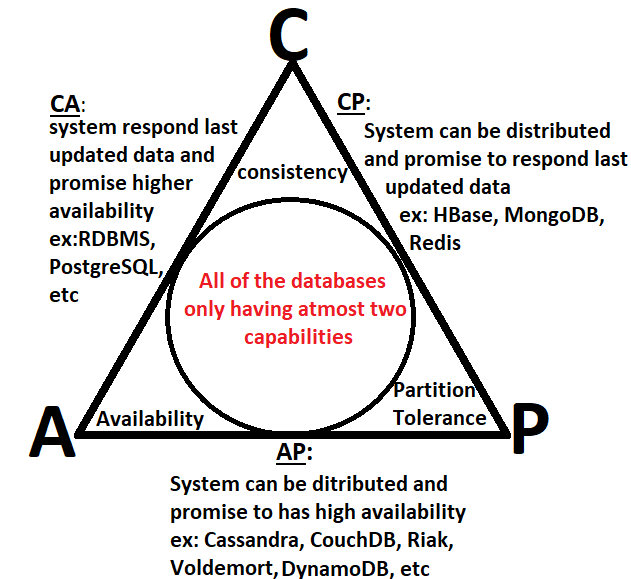
The CAP Theorem, also known as Brewer’s Theorem, is a fundamental principle in distributed systems that states that it is impossible for a distributed data store to simultaneously provide more than two out of the following three guarantees:
- Consistency (C): Every read receives the most recent write or an error. This means that all nodes in the system see the same data at the same time.
- Availability (A): Every request (read or write) receives a response, without guarantee that it contains the most recent write. This ensures that the system remains operational and responsive.
- Partition Tolerance (P): The system continues to operate despite arbitrary partitioning due to network failures. This means that the system can handle communication breakdowns between nodes.
Implications of the CAP Theorem
According to the CAP Theorem, in the presence of a network partition (P), a distributed system must choose between consistency (C) and availability (A). This leads to three possible configurations:
- CP (Consistency and Partition Tolerance): The system prioritizes consistency over availability. In the event of a network partition, the system may become unavailable to ensure that all nodes remain consistent. An example of a CP system is a traditional relational database that uses strong consistency models.
- AP (Availability and Partition Tolerance): The system prioritizes availability over consistency. In the event of a network partition, the system remains available but may return stale or inconsistent data. An example of an AP system is a NoSQL database like Cassandra, which allows for eventual consistency.
- CA (Consistency and Availability): The system prioritizes both consistency and availability, but cannot tolerate network partitions. This configuration is not feasible in distributed systems where network failures can occur.
Choosing the Right Configuration
When designing a distributed system, it is essential to understand the trade-offs imposed by the CAP Theorem and choose the appropriate configuration based on the application’s requirements:
- CP Systems: Suitable for applications where data accuracy and consistency are critical, such as banking systems or inventory management.
- AP Systems: Suitable for applications where availability is more important than immediate consistency, such as social media platforms or content delivery networks.
- CA Systems: Rarely used in practice due to the inevitability of network partitions, but may be applicable in tightly controlled environments with reliable networks.
Conclusion
The CAP Theorem highlights the inherent trade-offs in designing distributed systems. By understanding the implications of consistency, availability, and partition tolerance, system architects can make informed decisions that align with their application’s needs and priorities.
| « Scaling | » PACELC Theorem |
| Back to Core Architecture Principles | Back to System Design Concepts |